


Table of Contents
Intro
Uptime is one of the most critical stats for any business—and geolocation uptime is mission critical for regulated iGaming.
Regulatory geolocation compliance is essential for gameplay, which means geolocation verification is the gateway to revenue. Geolocation checks also directly impact player experience, which puts uptime at the core of a platform’s reputation.
But what is “good uptime” for geolocation services—how much do we really know about what goes into keeping these services switched on?
For some, the answer is a lot of big, shiny 9s written in a row, followed by a “%” and the word “uptime”.
The better answer (and the reason for this article) is that true availability, reliability, and resiliency runs much deeper than an uptime percentage. The 9s you can really trust aren’t flat—they’re crafted from layers and backed by infrastructure.
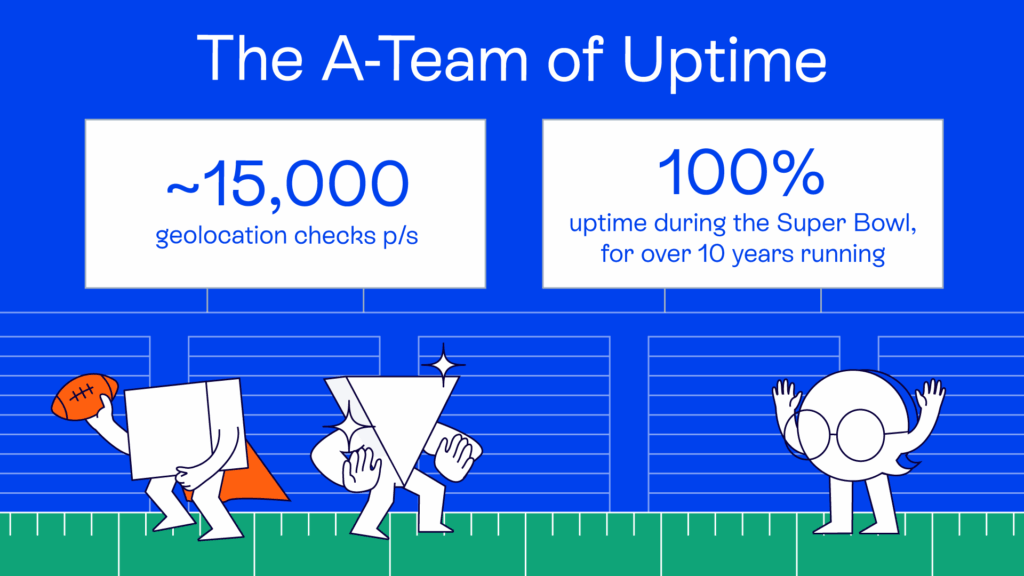
It’s easy to throw a number up on a website. It takes a lot more to receive and process ~15,000 geolocation checks per second and maintain zero reported player-impacting downtime during the Super Bowl—for over 7 years running.
When done right, all of this iron-clad infrastructure becomes a silent force that runs in the background so consistently you almost forget it’s even there.
We’ve brought in Rost Chernychenko, GeoComply’s Director of Engineering, to help us break down what’s behind the 9s and explain exactly what you should be looking for—and asking about—when it comes to high availability geolocation uptime and building out a robust resiliency strategy.
The strategic importance of geolocation availability and reliability
Availability, reliability, resiliency—oh my! These are key terms that get thrown around during conversations about uptime.

Availability is about being operational—it’s the probability of “you call, we answer”.
Reliability is about how consistent and dependable a system is when it is operational—it’s the probability of “you call, we answer when you expect and do what you expect, every single time”.
When it comes to iGaming, having excellent geolocation availability and reliability is critical for:
Business continuity and keeping revenue streams open
Bets can’t be placed if players can’t be traced—geolocating players is a regulatory requirement, which means if an iGaming operator’s geolocation service provider isn’t available, they’re not operational.
So, what’s the impact?: When geolocation is unavailable or unreliable, the operator is exposed to the immediate and complete loss of revenue from every affected player session—a risk that rapidly compounds during peak demand.
Engaging and retaining customers with seamless location verification
Delivering a good player experience is paramount—if geolocation is unavailable, players move on. If it’s unreliable and a check takes too long or a legitimate player doesn’t pass due to an error, they may abandon for another app.
So, what’s the impact?: This one’s harder to quantify—consider the lost revenue of that session, the wasted marketing spend on player acquisition, and the compounding cost of re-engagement. And then multiply that across the entire player base that’s impacted.

Maintaining a good reputation
It’s not just about doing it, it’s about doing it right—unreliable geolocation that allows illegitimate players to slip through the cracks or fails to trigger checks at mandatory times can lead to regulatory issues and fines.
So, what’s the impact?: Unreliable geolocation leaves iGaming operators exposed to significant compliance risks, including the potential for high-profile regulatory fines or license review and revocation due to systemic failure to meet mandatory checks.

Let’s talk 9s: The down-low on uptime
So, if availability refers to your geolocation provider being on, the question is: “are they conducting geolocation checks?”
And if reliability refers to your geolocation provider being efficient, the question is: “are they doing a good job at it?”
Both are critical—but how are they quantifiable?
(This is the part where the 9 swoops in.)
Quantifying availability
If there’s one metric that encapsulates availability, it’s the 9—specifically a handful of them, written in a row with a juicy percentage symbol and the word “uptime” at the end: 99.9% or 99.99% or (ta-da) 99.999% uptime. Looks pretty good, right?
But what does it actually mean?
“At the top of a website, a row of 9s presents as an impressive stat. However, they can become less meaningful once you begin to ask a few questions,” Rost says.
Let’s start with a story. A new driver has just backed out of the driveway and made it to the stop sign at the end of his street. He pulls over, parks, and claims to have an accident-free road record. Compare this to his dad, a long-haul truck driver who has a record earned over 10 years and 1,000,000+ miles of experience in snow, hail, rain, and glaring sunshine.
Grab your calculator, it’s time to do some math.
When it comes to uptime, this is how the 9s compare across a 1-year period:
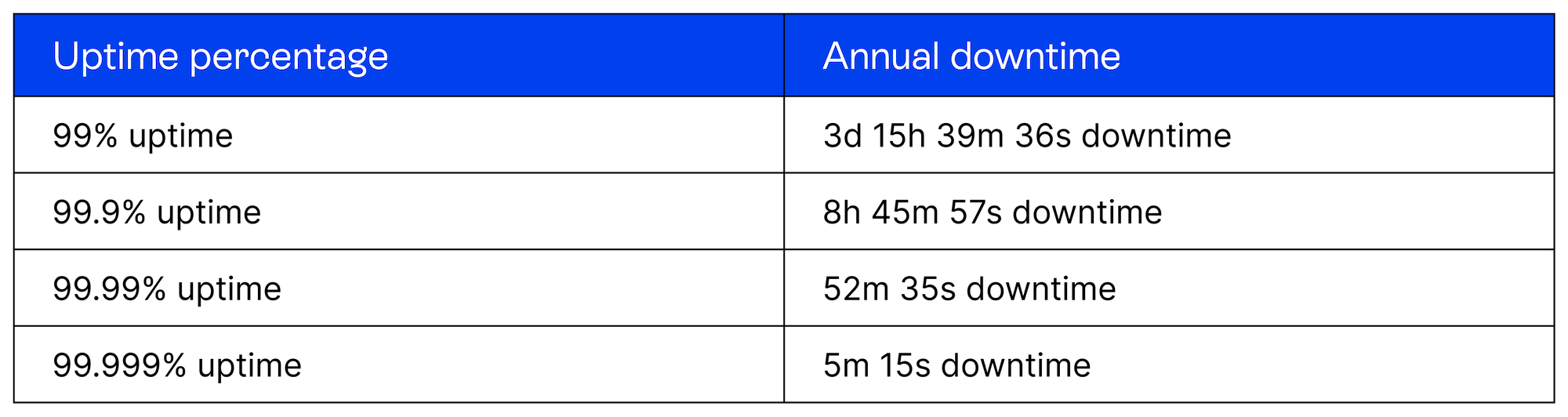
These numbers are accurate (based on the SLA industry-standard calculation of 365.25 days/year). But they don’t tell the whole story, either.
“Different service providers count downtime in different ways. Some may report impressive uptime stats despite having experienced major outages in select areas. Others may still be widely available, but they’re unable to handle large amounts of traffic or provide an efficient quality of service,” Rost says.
When you consider it from this angle, those 9s can start to look a little flimsy. Which is why availability doesn’t mean a lot without considering reliability.
Quantifying reliability
So, let’s assume the 9s are telling a true story and a geolocation service provider who claims 99.99% uptime is truly available for 525,907 minutes a year. How can you measure if those are good minutes?
“It’s not just about being available—our geolocation service must be able to effectively handle extreme and sudden traffic spikes, deliver high accuracy in buffer zones, work for mobile geolocation for people who are trying to place bets in limited-service areas such as subway stations or stadiums, and deliver a consistent and excellent service across all aspects of the user experience,” Rost says.
To add true meaning to their 9s, geolocation service providers need to be hitting the reliability notes on a high. There are a few different metrics that can help to define just how reliable they are:
- Transaction volume: How many geolocation checks is your provider processing on average?
- Scalability: How many geolocation checks have they handled during high-volume events, such as the Super Bowl or March Madness?
- Average pass rates: How many players are they passing on average, during both regular and high-volume periods?
- Near-border performance: How are players affected in high-density, near-border areas
- Latency: How long does it take for them to move your players through a geolocation check? Does this change during high-traffic events?
- Accuracy: How many false positives do they trigger? How many spoofers have slipped through the cracks?
- User experience: What’s the impact on your players, from their device battery to the messaging they see to their overall geolocation journey?
To really understand the 9s, you need to put on your 3D glasses
We’re not saying that “99.99% uptime” is a meaningless stat. But it doesn’t mean anything until you put on your 3D glasses and look at those 9s in terms of their breadth and depth.

First, consider availability—how long does this uptime period refer to, and how many minutes of real downtime does that include?
Next, think about reliability—during all that uptime, what quality of experience is actually being delivered?
We’ve asked a lot of questions. So, here’s our answers.
When we say we’re available, we mean it:
- Over the last 12 months, we’ve maintained 99.999% availability with zero outages that impacted players’ ability to geolocate or place wagers.
- Looking back over the last five years, that track record holds: 99.999% uptime, with less than 3 minutes of total downtime since 2021.
When we say we’re reliable, here’s what that looks like in practice:
- On an average day, we process 183,589 geolocation compliance checks per minute.
- During high-traffic events—think championship games or major sporting finals—that number surges to approximately 14,900 transactions per second.
- Across all that volume, we maintain an average eligible user pass rate above 99.5%, meaning legitimate players move through our checks smoothly and consistently.
When we say we’ve solved the near-border challenge, here’s what we’re talking about:
- Near-border performance can be a challenge, with major populations living near the border (which can amount to 5%-12% of traffic).
- Our dynamic near-border response technology can safely shrink buffer zones by up to 68% and improve pass rates by up to 4.5x in high-density border areas.
- This means fewer false rejections for legitimate players in places like New York City (near New Jersey) or cities along state lines.
When we say we’re fast, we’re talking about real player experience:
- The average geolocation check takes half a second—real-time, low latency verification.
- That’s fast enough that players barely notice the verification happening, which means they stay engaged instead of getting frustrated and abandoning the app.
“At GeoComply, we focus our resources on the specific agreements we have outlined with our partners. Rather than striving for a long string of 9s, we engineer our infrastructure to deliver mission-critical performance that meets (and exceeds) what we’ve set out in our SLAs. To do this, we look beyond ‘uptime’ and focus on how to ensure availability and reliability that delivers the best possible user experience—because, to us, those are the metrics that really matter,” Rost says.
Behind the 9s: Pillars of resilience
We’ve broken down the 9s and talked about how to figure out just how robust they really are. But how do they get that strong in the first place?
And how can you trust things will remain this way?
It’s time to talk resiliency.

Resilience refers to a system’s ability to remain operational, adapt to changing conditions, and recover quickly from potential disruptions—it’s the “you call, and this is how I’m able to consistently deliver high uptime and high-quality service.”
And it’s not a one-and-done deal.
“At GeoComply, we look at resilience as a holistic strategy for preventing geolocation downtime that involves a combination of innovative, infrastructural components as well as procedural, people-powered efforts,” Rost says.
Load balancing and scalability
When we talk about load balancing and scalability, we’re talking about the difference between a wooden footbridge and the Golden Gate Bridge. High availability systems need to be able to handle varying levels of traffic and scale to accommodate spikes in activity.

“As a geolocation service provider, load balancing is a critical aspect of our resiliency strategy. Our system has to be able to handle traffic on Super Bowl Sunday (flashback to those ~15,000 geolocation checks per second) with the same ease as it does on a typical Wednesday afternoon,” Rost says.
To do this, load balancers are critical. These are infrastructural components that can distribute and direct incoming traffic across your resources to:
- Prevent overload and optimize performance and stability under high traffic.
- Continuously monitor the health of the backends and react accordingly (triggering failover mechanisms when necessary).
- Handle traffic spikes by auto-scaling systems to dynamically add or remove backend instances based on load.
“We’re constantly monitoring and tuning our load balancers to handle traffic spikes. This requires a lot of collaboration between teams, so we can analyze historical traffic, create predictive models, and test our infrastructure,” Rost says. “High availability is not just about supporting high levels of activity, but maintaining our high quality of service throughout.”
Redundancy
This is the backup plan—the answer to “what if I call and for some unexpected reason the line goes fuzzy or gets disconnected?”
The goal of redundancy is to eliminate any single point of failure (or, as Rost would say, SPOF) that could lead to a complete outage. A good redundancy strategy includes duplicate instances of critical components, so one failure doesn’t bring down the entire operation.
When done well, redundancy covers critical hardware, software, services, and networks. “For example,” Rost says, “GeoComply runs on a multi-cloud failover setup with both AWS and GCP. We also give our customers access to a completely independent failover solution called Carbon, which they can switch on if our critical systems are unavailable.”
Failover mechanisms
So you have all your mission-critical hardware, software, services, and networks in place—but what happens if you actually need them?
That’s where automated failover mechanisms come in.
Failover mechanisms are set up to automatically detect failures and seamlessly switch traffic and operations to the redundancy plan in order to prevent geolocation downtime. Remember those 9s? Automated failover allows systems to recover quickly, without human intervention, which prevents (or at least minimizes) downtime.
But to do this, you’ve got to keep close watch. We’re talking continuous health checks of your active components, so if something goes wrong, such as a server goes down or a service crashes, the failover mechanism can kick in and reroute traffic to the redundant counterpart.
Generally speaking, there are two main failover strategies considered for geolocation failover best practices:
- Active-Passive: Plan A handles all traffic, while Plan B waits on standby, ready to take over if something goes wrong with Plan A and the failover mechanism kicks in.
- Active-Active: Rather than having a backup waiting in the wings, multiple instances handle traffic at the same time. If one fails, the failover mechanism distributes all the traffic to the other one.
““An Active-Passive approach can be simple to manage, but means resources are underutilized. Our live-live—or active-active—multi-cloud AWS and GCP setup enables us to make better use of our resources and trigger a faster disaster recovery plan, should an issue arise,” Rost says.
A word of warning: Don’t go chasing waterfalls (when you already have one)
Having a robust redundancy and automated failover plan is a critical part of your disaster recovery strategy. But, just as with every other aspect of your infrastructure, there are important considerations to make.
“Sometimes, third-party failovers aren’t the best solution. Beyond the financial cost of maintaining an extra provider (and the resource cost of onboarding and coordination for your team), introducing another component can bring more complexity than it solves for,” Rost says.
When it comes to building out your failover strategy, it’s important to think about:
- The customer impact: Can you ensure a consistent, high-quality user experience across a variety of different platforms?
- Your competitive edge: Will it impact your data consolidation or pose risks to your market share?
- Fraud and security: Will you open your business up to vulnerabilities?
Carbon is a geolocation failover solution that all GeoComply customers have access to, free of charge. It acts as an additional layer of resilience that ensures iGaming operators can comply with regulations and keep their revenue streams open, allowing business continuity no matter what.

It’s designed as a comprehensive database that’s built from the GeoComply Core engine. Operators host their own local version of Carbon, which is updated regularly via API. That means you have a built-in backup plan with up-to-date data, ready to kick in if you need it.
“Whether it’s a planned maintenance window or a worst-case-scenario situation in which our servers become unavailable, you can switch over to Carbon and continue to pass your trusted players,” Rost says. “For technology leaders, it’s contingency, continuity, and peace of mind about downtime all at once.”
Independent verification and compliance
Of course, it’s one thing for us to say all of this. But resilient systems aren’t just self-reported—they’re independently verified. Our high availability infrastructure undergoes regular third-party audits to ensure we meet the highest standards for security, availability, and operational excellence.
“At GeoComply, we maintain SOC 2 Type II certification, which means our controls are independently audited by certified professionals,” Rost says. “We also utilize third-party monitoring tools that track our uptime and performance in real-time, providing an objective measure of our service delivery.”
Questions we should all be asking about reliability, availability, and resilience
Whether it’s a payment platform, a KYC provider, or your geolocation vendor, there are some key questions we should all be asking our partners to ensure we’re getting the best possible reliability, availability, and resilience.
This is the checklist that our team uses when we’re vetting potential service providers (along with the answers Rost provides when our customers ask us the same things).
What is your redundancy and failover strategy?
How do you monitor the performance of these systems?
What is the incident response plan in event of an issue or outage?
If something unexpected happens, what is the communication strategy?
How do we integrate in a way that helps us avoid issues?
How have you applied your learnings to your existing infrastructure?
How do I know if you’re reliable?
We might have left you with more questions than answers, but that’s because uptime isn’t just a math equation—it’s a history lesson, an engineering exercise, and a masterclass in planning and strategy. And that means the answer to “what’s your uptime?” shouldn’t just be a bunch of 9s in a row.
“Yes, the 9s can be a great representation, but they’re only powerful when they’re backed by robust systems that provide a high-quality experience that can truly support your mission-critical services,” Rost says.
Despite all the words we’ve put into exploring geolocation uptime, it’s not something an operator should ever have to think about—we put resiliency at the core of our company culture, so, as far as our partners are concerned, it just works.
As you might have suspected, we’re kind of obsessed with uptime. Our engineers are always game to chat about how we’ve consistently delivered some of the biggest, strongest 9s—and how we’re working to get even better at it every single day. If you want to learn more (or grill us on any of the questions we challenged you to ask) get in touch with our team.