

Varying threat vectors, one playbook
The threat landscape facing AI labs is complex and well-documented, and is often broadly sorted into two categories.
- Attacks targeting the capabilities of a specific model as their end goal. This encompasses threats such as adversarial distillation.
- Attacks employing AI as an enabling tool for other illicit, unethical, or dangerous activities. This covers the use of advanced AI for activities ranging from cyber-enabled fraud to potential emerging threats, like bioterrorism.
These threats vary widely in impact and consequence, but the tools and techniques behind them are strikingly consistent across threat typologies. Criminals universally strive for anonymity. No illicit enterprise can be sustained if the identities, devices, accounts, and locations of these bad actors can be identified and blocked.
The anonymity playbook is everywhere
When companies aligned with U.S. geopolitical rivals run adversarial distillation attacks against U.S. firms, obfuscation techniques are ubiquitous.
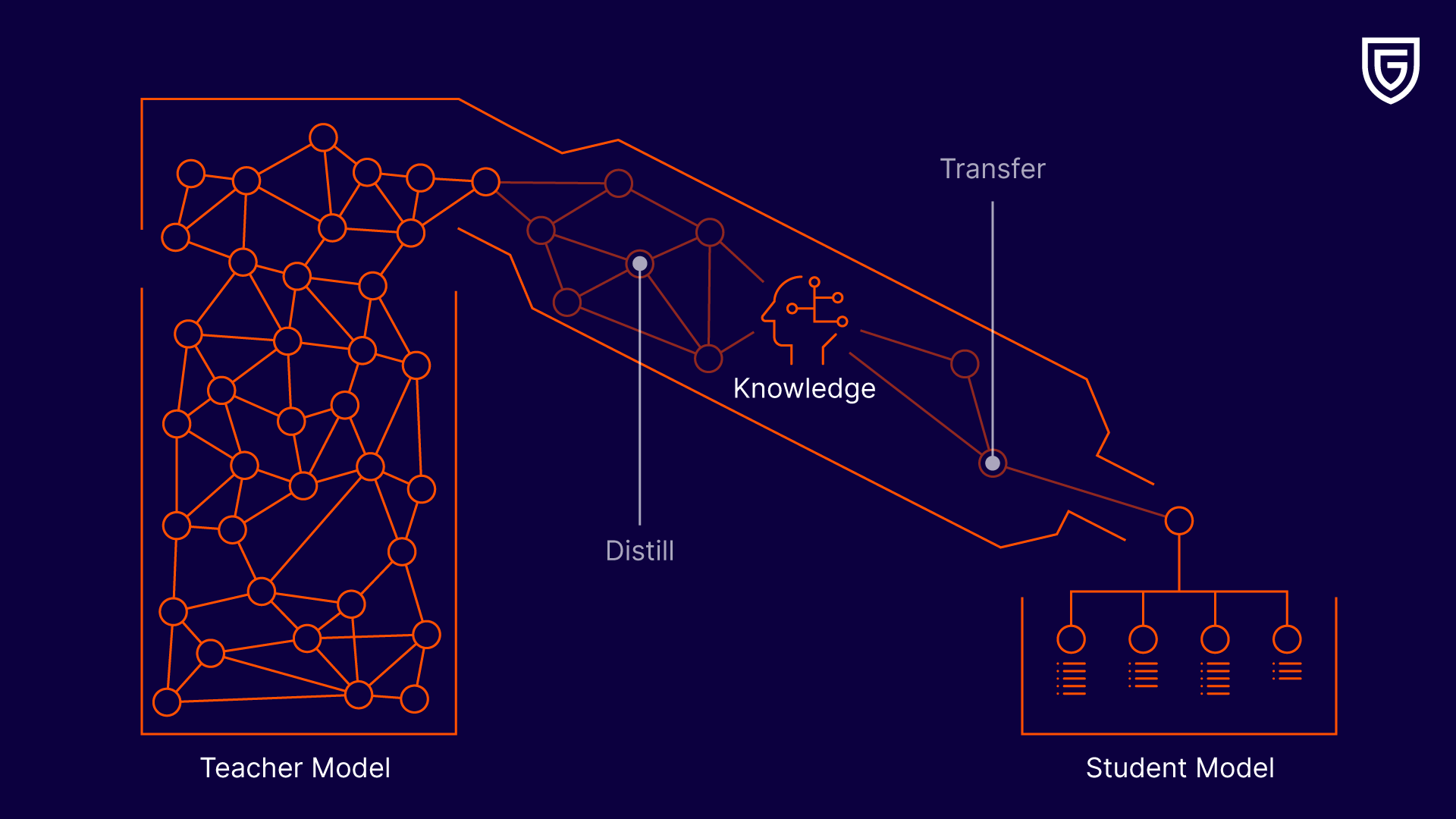
AI providers have uncovered sprawling “hydra cluster” operations—networks of tens of thousands of fraudulent accounts distributed across their APIs and third-party cloud platforms—deliberately mixing model-extraction traffic with normal customer requests to make detection harder.
Attackers have also been observed reaching models through obfuscated third-party routers and resellers that mask the true source of their traffic. Frontier labs have warned government oversight bodies that these extraction techniques are turning to new, obfuscated methods.
This is not unique to distillation attacks. Across numerous other criminal typologies, leading AI models and digital obfuscation tools are used hand-in-hand to sophisticate and scale crimes, while reducing digital signatures.
How threat actors exploit anonymity and AI
Scam centers
In Southeast Asia, scam center operations rely on AI tools for scalable fraud and VPNs for scammer anonymity.
IT worker fraud
North Korean IT worker fraud, a major emerging counterintelligence and sanctions compliance challenge, is augmented by fraudulent identities, remote laptop farms, and AI tools.
Terrorist and insurgent groups
Terrorist and insurgent groups are increasingly relying on AI to support operations. Such groups are also known to use VPNs and similar technology to anonymize their online activity.
Model-level safeguards are essential, but they only go so far. Rooting out abuse means acting at the user, account, and device level. The good news: while these anonymizing tactics are a serious challenge, they’re not an unbeatable one.
Effectively detecting and countering illicit networks comes down to better identification practices built on persistent identifiers that are hard to spoof. That is why any leading AI platform should treat precise, verifiable, compliance-grade geolocation as a core safeguard, not an afterthought.
The threat spectrum: Unpacking the spoofing arsenal
Not all spoofing is equal, and the sophistication of a particular technique often signals the level of threat posed by the actor behind it. At the most basic level are consumer VPNs and off-the-shelf proxy services. These tools are cheap, widely available, and easily detected by even basic IP reputation checks. More advanced threat actors graduate to residential proxy networks that route traffic through compromised or rented home IP addresses, making malicious traffic indistinguishable from ordinary consumer activity.
At the highest level, well-resourced actors combine GPS and location spoofing, virtualized or emulated devices, SIM farms, and synthetic device fingerprints to construct entire fabricated digital identities, complete with a realistic location, device history, and behavioral pattern. Each rung up this ladder demands progressively more resources and technical skill, but also yields progressively greater resistance to detection.
Commodity tools
Cheap, widely available, and caught by even basic IP reputation checks.
Residential proxy networks
Traffic routed through compromised or rented home IP addresses, making malicious activity indistinguishable from an ordinary consumer.
Fabricated digital identities
Well-resourced actors construct entire fake identities—complete with a realistic location, device history, and behavioral pattern.
Advanced spoofing: The danger of layered threats
The most dangerous actors do not select a single technique in isolation; they layer multiple spoofing methods to compound their anonymity and defeat any single point of detection. A fraudulent account might pair a residential proxy with a spoofed GPS location and an emulated device profile, so that IP-based, location-based, and device-based checks each independently return a false negative.
This layering effect explains why hydra clusters and similar spoofing models are so difficult to unwind: no single signal is spoofed so crudely that it triggers an alert, but the combination is entirely fabricated. The line between actors who get caught fast and actors who operate undetected for months or years is not the underlying crime. It is the sophistication of the spoofing toolkit. Those tools get commoditized and show up on criminal marketplaces, even lower-tier actors are picking up techniques that used to belong to state-sponsored operations.
Compliance-grade geolocation to counter multifaceted threats
When threats are multi-dimensional, the defenses have to be as well. Establishing persistent identifiers based on location and device attributes helps organizations flag digital deception before networks expand and threats expand.
No single location signal is enough on its own. Each can be spoofed, masked, or manipulated in isolation. But when multiple independent signals are cross-validated against one another, the cost and complexity of maintaining a consistent false location rises sharply. This is the core logic of compliance-grade geolocation: it does not depend on one data point being unspoofable. It relies on the near-impossibility of spoofing several independent, cross-referenced sources at once, consistently.
The signals: What each geolocation source catches
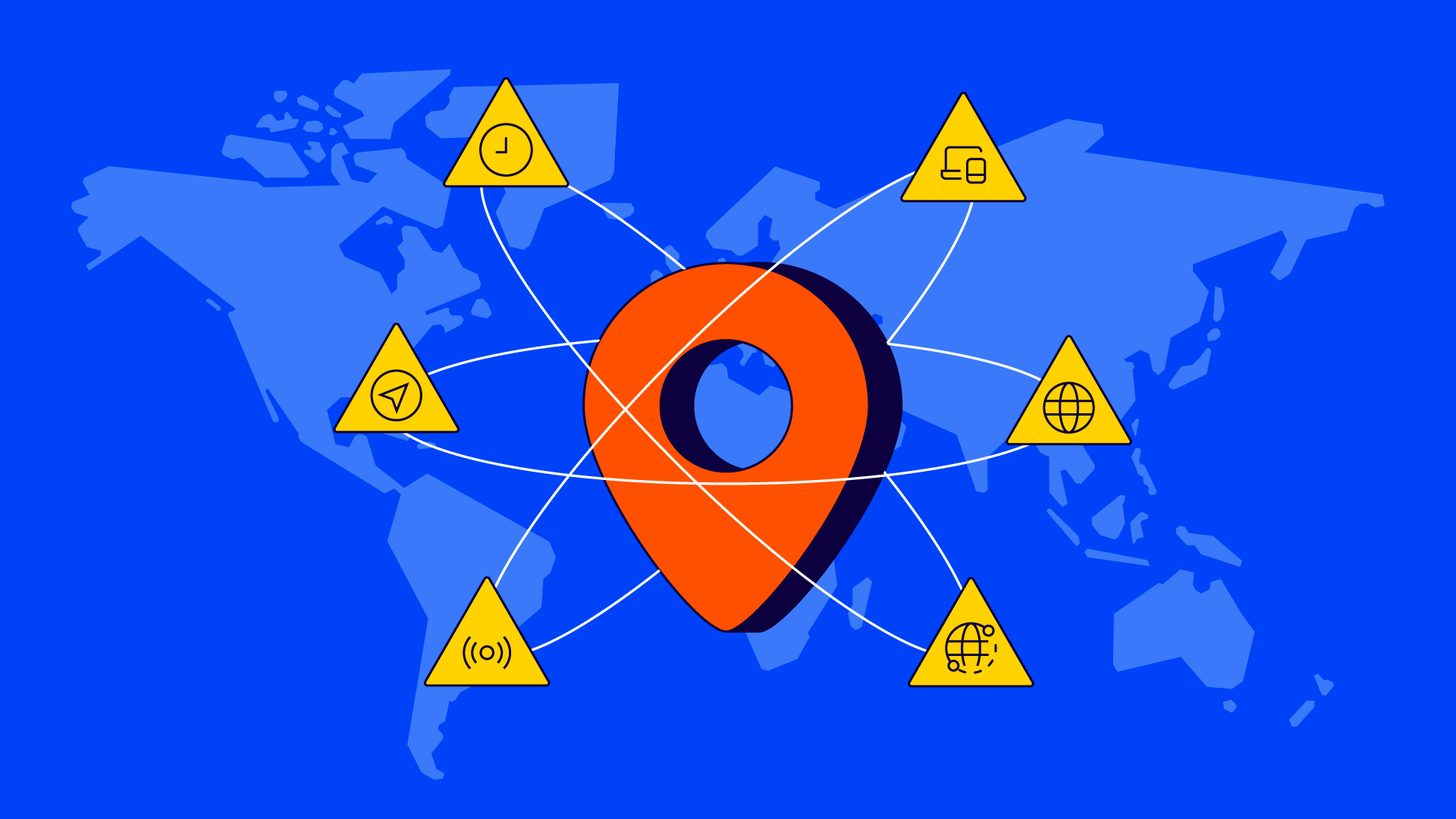
Effective compliance-grade geolocation draws on complementary signals, each with distinct strengths and blind spots:
The layers behind a verified location
IP address
Offers a baseline, low-cost signal, but is also the easiest to obscure through commercial VPNs, proxies, and residential proxy networks, making it insufficient as a standalone indicator.
Latency measurements
Assesses the round-trip time of network signals can reveal inconsistencies between a user’s claimed location and their true physical distance from network infrastructure—flagging cases where a spoofed IP suggests one location but the underlying network physics suggest another.
Cell tower triangulation
Grounds a device’s location in the physical infrastructure of mobile networks, offering a signal that is far more difficult to falsify remotely than software-based indicators like IP address.
Wi-Fi positioning
Cross-references a device’s visible wireless networks against known access point databases, providing a granular, often building-level signal that is difficult to spoof without physical proximity.
GPS data
Precise, but also directly manipulable through widely available spoofing applications and hardware—underscoring why GPS alone cannot be treated as ground truth and must be validated against other sources.
Seeing the whole picture: Adding device-level intelligence
Location is only part of the picture. Device-level indicators add a further layer of verification. Device fingerprinting—encompassing hardware identifiers, operating system configuration, browser or application characteristics, and behavioral patterns—helps distinguish a genuine, unique user from an emulated device or virtual machine designed to mimic one.
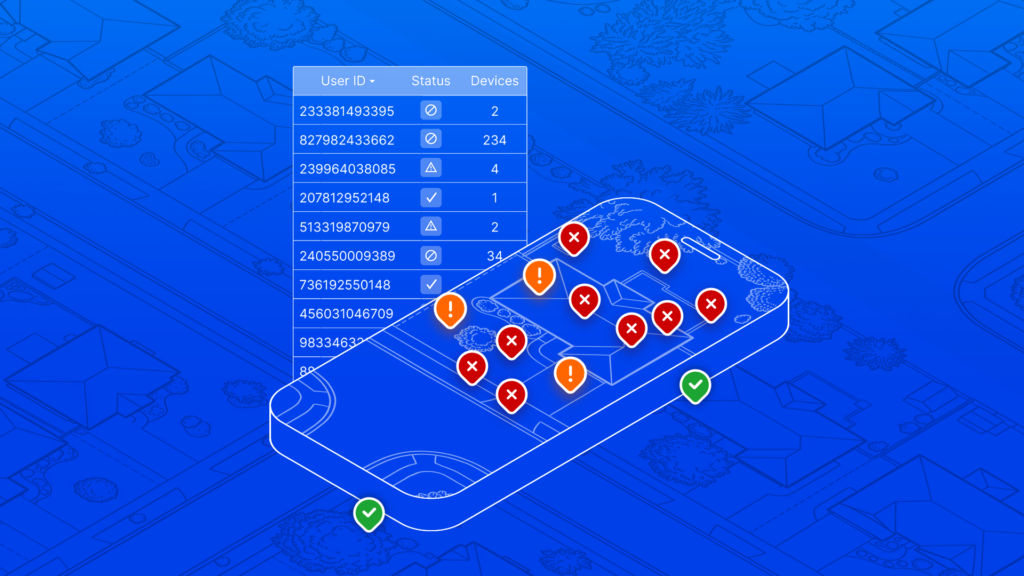
When an account’s claimed location, network path, and device profile are all internally consistent and corroborated across sources, confidence in that account rises. When they diverge, say a fingerprint that looks like an emulator paired with a GPS location that contradicts the cell-tower data, that divergence becomes a high-value signal in its own right. It is often exactly how the coordinated, high-volume abuse architectures surfaces.
Ultimately, compliance-grade geolocation shifts the burden back onto the attacker. Beating a single-signal check means spoofing one data point. Defeating a well-designed compliance-grade system means constructing and maintaining a fully coherent false reality across network, hardware, and physical-world signals at once, representing a bar few organizations can successfully clear.
Adjustable friction: Security that does not punish growth
For fast-growing AI labs with a global footprint, security cannot come at the expense of adoption. For this reason, heavy-handed safeguards that restrict access for both legitimate and illegitimate users would be untenable. However, scaling security controls to account for initial risk indicators allow platforms to pass unsuspicious users quietly, and step up suspicious ones by adding friction and collecting more data only as the risk signals warrant it.
For example, a platform can run an initial location check on passive signals like IP address and latency. If the picture is coherent, the user moves on. If it is not, the platform can ask that user to consent to more detailed data points, such as GPS, Wi-Fi, and cell-tower data, before proceeding.
Scalable friction and user data analysis, when tuned to an organization’s risk tolerance, allows platforms to balance security against commercial needs, and scale the business safely.
Looking forward: what this means for AI platforms
AI platforms are being asked to do two things that pull in opposite directions: open the door wide enough to grow, and hard enough to keep sophisticated abuse out. Single-signal checks force a bad trade between the two. Compliance-grade geolocation enables both.
The logic is simple. No individual signal is unspoofable, but a coherent false identity across network, device, and physical-world signals is expensive to build and even harder to maintain at scale. Cross-referencing IP, latency, cell tower, Wi-Fi, GPS, and device fingerprints turns each spoofing attempt into a compounding problem for the attacker and a clear signal for you. Pair that with risk-based friction, and legitimate users pass without noticing while suspicious ones get progressively harder to fake.
For labs scaling globally, this is what lets security keep pace with growth instead of throttling it. The threat landscape will keep evolving. A platform that verifies identity and location across multiple independent sources is far better placed to evolve with it.
Interested in learning more on this topic? Read more on securing the AI ecosystem: Defending the AI frontier: Geolocation security in the global AI arms race

Jake Hulina | Government Relations Manager, GeoComply
Jake is the Government Relations Manager for New Verticals at GeoComply. In this role, he works on policy issues related to technology, financial services, security, and other emerging use cases.